
The need for Criticality Safety as a discipline emerged in the wake of the Manhattan Project at the end of the Second World War. It was during experimentation with subcritical assemblies, at the Los Alamos National Lab, that the first criticality accident occurred on 4th June 1945 when water moderated an enriched mass of Uranium into a critical state. Over the next 11 months there would be two more criticality accidents each concerning the ‘demon core’ (as it came to be known) and each resulting in a single fatality.
On the 21st August 1945 at the Los Alamos National Lab, Harry Daghlian accidentally dropped a tungsten carbide brick onto a sphere of plutonium (the demon core). The brick reflected neutrons back towards the sphere which resulted in a critical state. Harry Daghlian suffered fatal radiation poisoning and would go onto die 25 days later.
Again at the Los Alamos National Lab on the 21st May 1946, Louis Slotin was providing a demonstration with the demon core where he maintained separation of two beryllium hemisphere reflectors surrounding the demon core using a screwdriver. His screwdriver slipped, the hemispheres closed around the demon core which caused the assembly to go supercritical. He quickly reacted and disassembled the assembly. Eight people were injured in the accident with Louis Slotin dying from radiation poisoning nine days later.
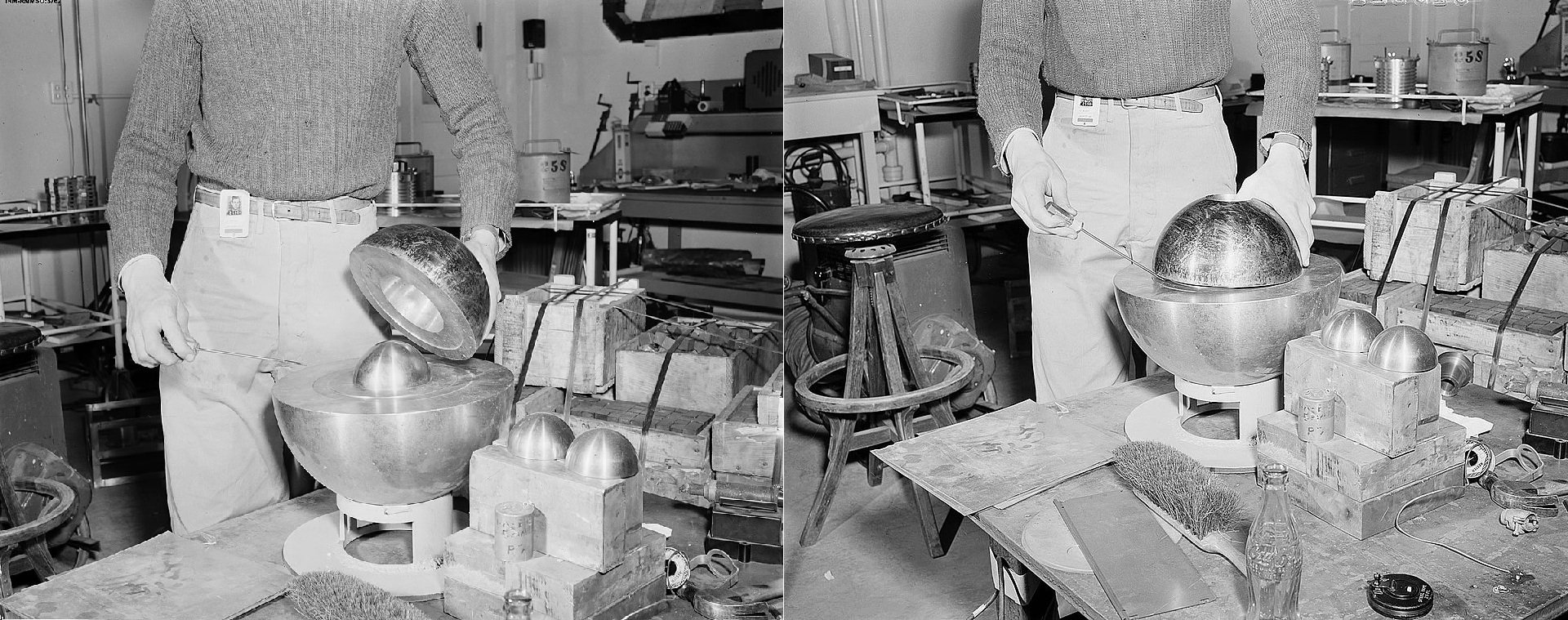
Since these events, there have been numerous other criticality accidents in different countries. All publicly known criticality accidents, the narrative of events leading up to the accident and the shortcomings that resulted in them occurring are recorded in LA-13638 – A Review of Criticality Accidents (2000 Revision). This document splits criticality accidents into two types:
- process accidents
- research reactor or critical experiment accidents
The delineation is justified on the basis that research reactors and critical experiments expect to reach a critical state. While in processing facilities carrying out operations with fissile materials, a criticality is usually avoided through a combination of passive, engineered and administrative controls. Operating personnel in processing facilities are usually not experts on criticality physics and may be working in close proximity with fissile material, therefore a criticality is a major hazard to those who work in these facilities and to the wider public in the vicinity.
Criticality assessors are, in most instances, concerned with processing facilities or environments, as criticality safety is often defined as:
“The prevention or termination of inadvertent nuclear chain reactions in non-reactor environments”